
Black-hat SEO in iGaming: 8 tactics compared, and where the law starts
Bought links, PBNs, expired domains, parasite pages, cloaking, hacked sites, fake takedowns. What each one does, what Google says, and which ones are crimes.
Key takeaways
- Five of the eight common tactics only break Google's rules. The worst case is lost rankings.
- Three of them, hacked sites, cloaking on hacked servers and fake copyright takedowns, are illegal in most countries.
- Every shortcut has a shelf life. One expired domain went from 4,000 to about 500,000 monthly visitors, then stopped working after about a month.
- Before you buy anything, ask the seller to name the tactic in plain words.
The short answer
"Black hat" is not one thing. Of the eight tactics you will run into most in iGaming, five only break Google's rules, so the worst case is that your rankings disappear. The other three break the law in most countries. Knowing which group an offer belongs to is the single most useful thing a buyer can learn.
Why this niche runs so hot
Gambling keywords are worth a lot, and the paid route is mostly closed. Google's own Ads Safety Report says it blocked or removed more than 270 million gambling and games ads in 2025, as reported by Asia Gaming Brief. When you cannot buy the click, everyone fights for the free one.
That pressure shapes behaviour. In a 2026 interview, the SEO Charles Floate said nearly everything that ranks in iGaming is black hat in practice. Agencies say the opposite, and neither side shows data. We covered that argument in where the experts disagree on casino links. Here we just lay the tactics out side by side.
The eight tactics, side by side
| Tactic | What it is, in plain words | Google's rule it breaks | What has been reported | Against the law? |
|---|---|---|---|---|
| Bought links | Paying a site to link to you | Link spam | Average niche edit costs $361 (Ahrefs) | No |
| Private blog networks | Your own ring of sites that link to your money site | Link spam | Targeted by Google's March 2026 spam update | No |
| Expired domains | Buying a dead domain for its old links | Expired domain abuse | 448 of 3,692 audited auction domains became gambling sites | No |
| Parasite pages | Renting a page on a trusted site | Site reputation abuse | Manual penalties since May 2024, policy widened in November 2024 | No |
| Mass-produced pages | Thousands of near-identical pages, often AI-written | Scaled content abuse | Templated pages reportedly fell 30-50% in March 2026 | No |
| Cloaking | Showing Google one page and people another | Cloaking | Usually found together with hacked sites | On a hacked site, yes |
| Hacked sites | Breaking into someone's site to plant pages or links | Hacked content | 163 organisations hit in one Thai-market campaign | Yes |
| Fake takedowns | False copyright claims to remove a rival's page | Abuse of removal requests | 117,000+ confirmed false notices in one lawsuit | Yes |
One more that belongs on the list is click manipulation, where bots fake searches and clicks. Floate describes it as common. Nobody has published numbers on it.
What paid links actually cost
The best public numbers come from Ahrefs, which emailed 450 sites about niche edits and 180 about guest posts across nine competitive niches.
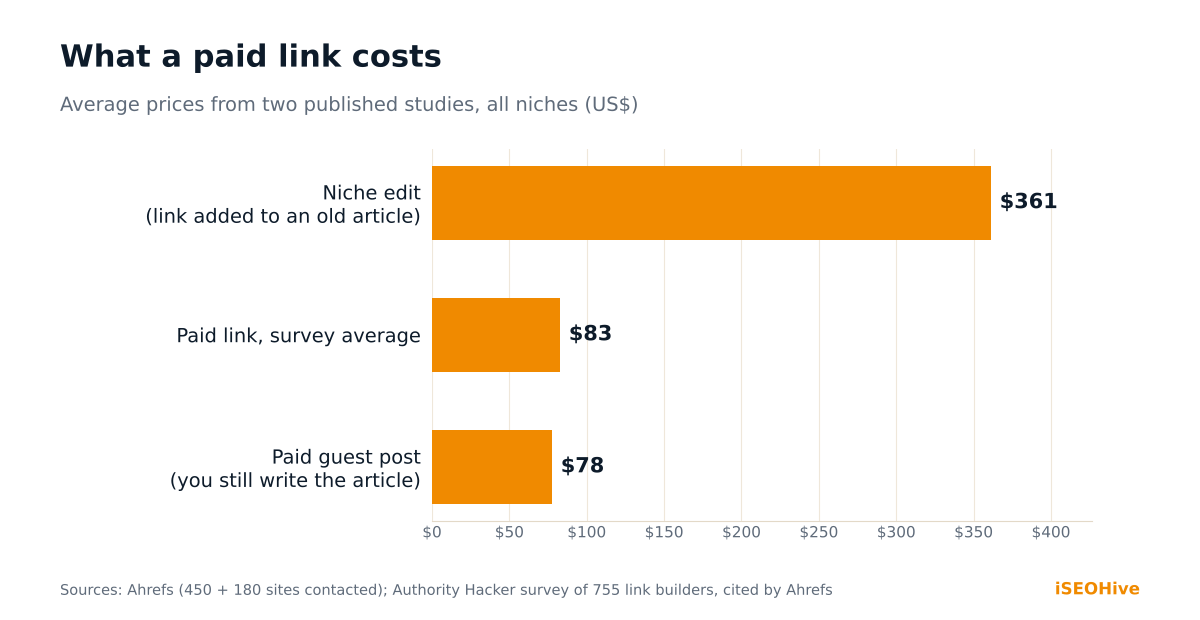
A few things to notice:
- A niche edit, where your link is added to an article that already exists, averaged $361. Only 12.6% of the sites asked were willing to sell one.
- A paid guest post averaged $78, but you still have to write the article.
- A separate survey of 755 link builders, cited by Ahrefs, put the average paid link at $83.
These are not gambling prices. Loopex Digital cites $200 to $800 for a gambling niche edit, and Nikolay Krastev estimates gambling links cost three to five times more than in other niches. Both are single-source figures, so treat them as a rough guide.
Every shortcut has a shelf life
This is the part sellers skip. The question is rarely "does it work?" Often it does. The question is "for how long, and what is left afterwards?"
Domain Name Wire followed one expired domain, a former brewery site that was getting 2,000 to 4,000 visits a month. It sold at auction for $6,086 and was turned into a Turkish gambling site. The next month it reached about 500,000 organic visitors. Then Google appeared to catch up, and the tactic stopped working after about a month.
The same pattern shows up elsewhere. Parasite pages worked until Google started handing out manual penalties in May 2024. Blog networks worked until, according to Milan Novakovic's summary for iGB Affiliate, the March 2026 spam update wiped out the value of those links, and it did not come back.
Where the law starts
The first five rows in the table are a business risk. You are betting your rankings, and you can lose the bet.
The last three are different. Breaking into a government website is a crime whether or not it helps your rankings. Filing a false copyright notice is unlawful too. The victims are real: public agencies, universities, and honest affiliates who lose their income overnight. We go through both in detail in how gambling pages end up on government websites and fake DMCA takedowns.
If a seller offers cheap ".gov" or ".edu" links and cannot explain where they come from, assume the worst and walk away.
What a buyer should ask
- What exactly is the tactic? Make the seller say it in plain words. "Authority placements" is not an answer.
- What is the shelf life? Ask what happens to your site when it stops working.
- Where do the links come from? If the answer involves sites the seller does not own or have a deal with, stop.
- What is the record? Ask for dates: when links went live, and whether they are still live.
Questions and answers
Is black-hat SEO illegal?
Most of it is not. Buying links, running blog networks, using expired domains and renting parasite pages break Google's rules, not the law. Hacking websites and filing false copyright notices are illegal in most countries.
Does black-hat SEO still work in iGaming?
Reports say it often works for a while. The documented cases show short lifespans, such as an expired domain that reached about 500,000 monthly visitors and then stopped working after about a month.
What does a paid link cost?
Ahrefs found an average of $361 for a niche edit and $78 for a paid guest post across nine competitive niches. Published estimates for gambling are higher, at roughly $200 to $800 per niche edit.
Sources
- Ahrefs: Should you buy backlinks? (link price study)
- Asia Gaming Brief: Google blocks over 270m gambling ads in 2025
- James Dooley podcast: iGaming SEO 2026, interview with Charles Floate
- Casino.org: Offshore gambling sites spent millions on expired domains (Backlinking.com study)
- Domain Name Wire: Expired domains and iGaming buyers at NameJet and SnapNames
- Google: New ways we're tackling spammy, low-quality content on Search (March 2024)
- Search Engine Roundtable: Google site reputation abuse policy expanded (November 2024)
- Milan Novakovic, iGB Affiliate: The update storm, H1 2026 in search
- Maria Harutyunyan, Loopex Digital: How to build gambling and casino backlinks
- Nikolay Krastev, SEO Fellas: Link building for iGaming
- The Cyber Express, via Pulse: 163 organisations hit by Thai gambling SEO poisoning campaign
- Chavdar Vasilev, CasinoBeats: Affiliates under attack, the growing threat of DMCA abuse