
Fake DMCA takedowns: the dirtiest trick in iGaming SEO, and how to protect your pages
Rivals can get your page pulled from Google with a false copyright claim. How the trick works, how big it is, and the steps to get your page back.
Key takeaways
- Google can remove a page after a copyright complaint before anyone checks whether the claim is true.
- One lawsuit describes 65 Gmail accounts sending more than 117,000 confirmed false notices.
- A gambling affiliate reported over 50 takedown requests in 30 days and got one reply.
- Your defence is speed: spot the removal, file a counter-notice the same day, and keep proof that you wrote the page first.
The short answer
Someone who wants your page gone can file a copyright complaint against it, even a completely made-up one. Google may remove the page first and sort out the truth later. You cannot stop the complaint being filed. What you can do is notice fast and respond the same day.
How the trick works
Under the US copyright law known as the DMCA, anyone can tell Google that a page copies their work. Google's own Transparency Report admits it cannot always verify these requests and cannot always warn the site owner before a page is removed, as Search Engine Journal reported in July 2026.
So the attacker picks a rival page that ranks for a valuable keyword and files a notice. CasinoBeats describes the common versions:
- The invented owner. A made-up company claims the article is theirs.
- The back-dated copy. The attacker copies your article, republishes it with an earlier date, then claims yours is the copy.
- The fake regulator. A notice dressed up to look like it comes from a gambling authority.
While the page is out of Google, the attacker's own page moves up.
How big is it?
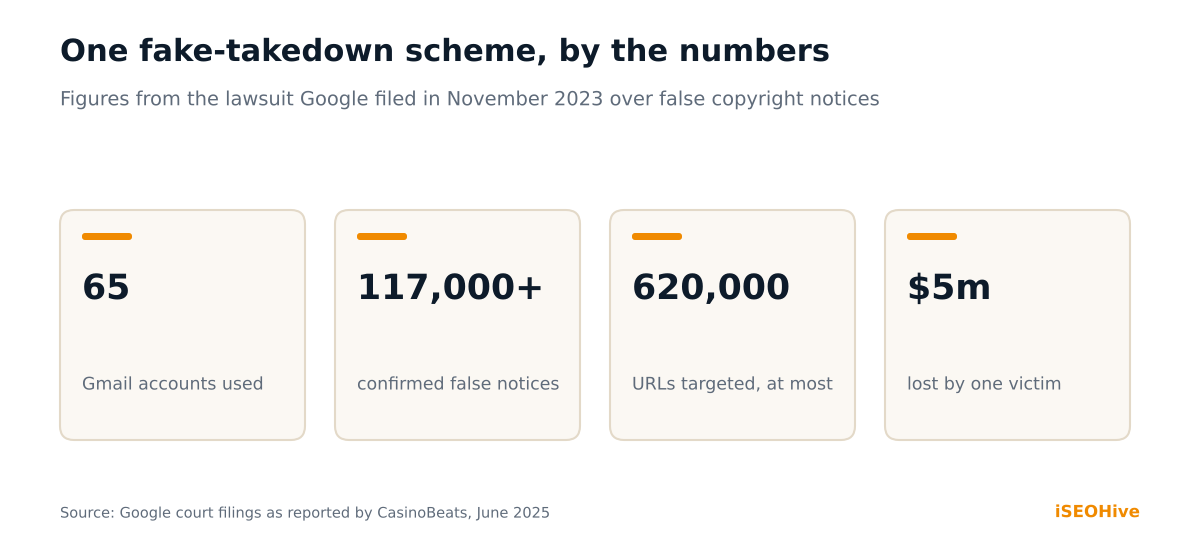
In that case, Google sued two people it accused of running a takedown operation. According to the court papers, they used at least 65 Gmail accounts to send more than 117,000 confirmed false notices, and nearly 500,000 suspected ones, against as many as 620,000 URLs. One business lost about $5 million in revenue after more than 35,000 of its URLs were removed during the holiday season.
Other numbers from the same CasinoBeats report:
| What | Figure |
|---|---|
| False notices logged by the Lumen research project, 2019 to 2022 | Nearly 34,000 |
| Share of those that failed | About 99% |
| Valid URLs wrongly removed anyway | About 300 |
| Further questionable notices Lumen flagged in 2024 | About 60,000 |
| Requests one gambling affiliate received in 30 days | More than 50 |
| Replies that affiliate got from Google | 1 |
Charles Floate goes further and says some iGaming operators receive hundreds of notices a day. That is his account, with no data attached.
It is not only affiliates. Search Engine Journal reported that the trade publication Press Gazette had two investigative articles removed from Google in 2026 after anonymous complaints. One was restored within about a day. The other was still gone when the story ran.
How to spot a removal
- Search your own titles. If a page has been removed, Google shows a notice at the bottom of the results that links to the complaint.
- Watch single pages in Search Console. A page that drops to zero overnight while the rest of the site is fine is the pattern to look for.
- Search the Lumen database for your domain. Lumen archives takedown notices. A notice there shows what was requested, not that the claim was true.
How to get your page back
- File a counter-notice the same day. Use Google's DMCA process. Every day you wait is a day out of the results.
- Expect a wait. Search Engine Journal notes a period of 10 to 14 business days after a valid counter-notice. The affiliate in the CasinoBeats report waited far longer.
- Bring proof. Timestamped drafts, your CMS history and public web archives all help show you published first.
- Keep a log. List every notice, the date, the claimed owner and the status. Patterns such as the same odd claimant name help your case.
Signs that a notice is fake, according to CasinoBeats: the claimant's name does not match any real business, the country makes no sense, or the "original" is in a different language from your page.
Before it happens
- Save dated copies of every important page when you publish it.
- Check your top 20 pages weekly, by title, in Google.
- Do not put all your income on one page that one notice can remove.
Do not fight back the same way
It is tempting. Don't. A knowingly false notice is unlawful, and US law lets the victim sue for damages. Google has shown it will take people to court over it. This is general information, not legal advice. If you are losing serious money, talk to a lawyer.
Questions and answers
Can a competitor really remove my page from Google with a false copyright claim?
Yes, temporarily. Google can remove a page after a DMCA complaint before the dispute is resolved, and it says it cannot always verify requests. You get the page back by filing a counter-notice.
How long does it take to restore a page after a fake DMCA notice?
Search Engine Journal reports a waiting period of 10 to 14 business days after a valid counter-notice. Some cases are faster and some take much longer.
How do I check if my site has been hit by DMCA notices?
Search Google for your page titles and look for a removal notice at the bottom of the results, watch for single pages dropping to zero in Search Console, and search the Lumen database for your domain.