
Expired domains in iGaming: what $22 million of auction sales tells us
An audit of 3,692 auctioned domains found that 448 became gambling sites. The prices, the real examples, and how long the trick actually lasted.
Key takeaways
- An audit of 3,692 auctioned domains worth $22.3 million found at least 448 were turned into gambling sites.
- About 1 in 5 domains that sold for more than $25,000 became a betting site.
- One $6,086 domain reached about 500,000 monthly visitors as a gambling site, then stopped working after about a month.
- Google treats buying a dead domain mainly to rank low-value content as spam.
The short answer
Gambling buyers are among the biggest spenders at expired-domain auctions, and the more expensive the domain, the more likely a casino is behind the bid. The documented cases show it can work spectacularly, and briefly.
What the audit found
In October 2026, Casino.org reported on a study by Backlinking.com, a publication that tracks domains. It audited domains sold at auction between January 2024 and May 2026.
- 3,692 domains audited, sold for a combined $22.3 million
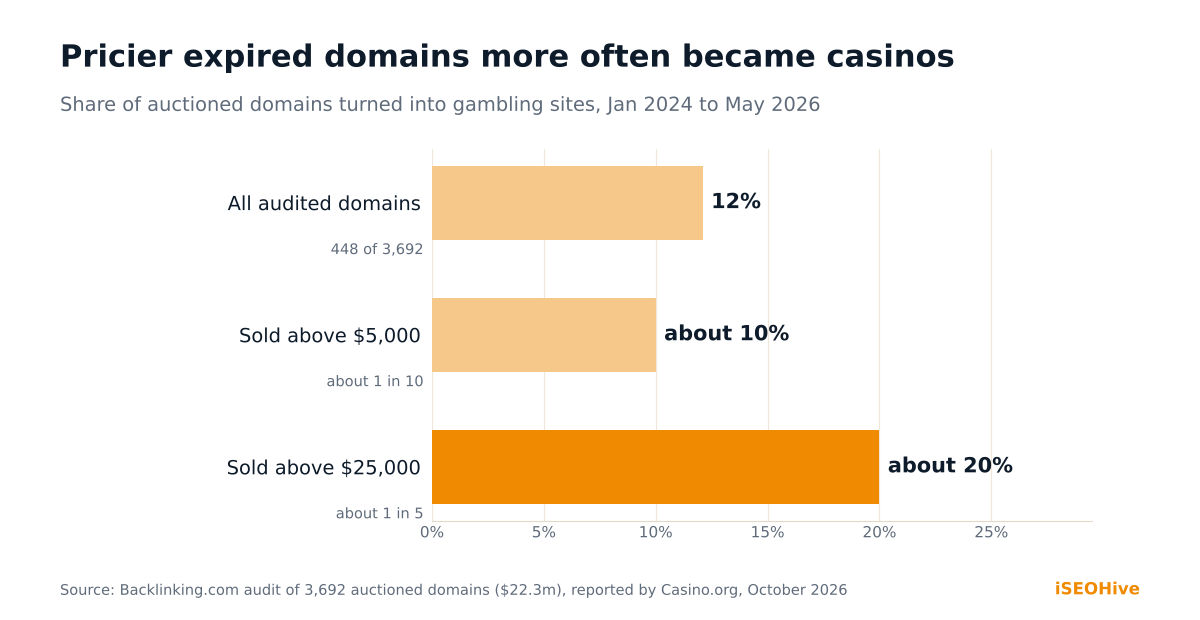
- At least 448 became gambling sites, about 12%
- Among domains that sold for more than $5,000, about 1 in 10 became a betting site
- Above $25,000, about 1 in 5
The names are the uncomfortable part. The study found the former domain of a royal tree-planting charity pointing to an Indonesian slot page, the old website of a UN-backed health initiative leading to a casino, and a former political campaign site listing unregulated casinos. The gambling sites were hosted in the Philippines, Curaçao, Malta, the Isle of Man and Indonesia.
Why anyone pays that much
When a website dies, the links pointing at it do not. A news article from 2019 still links to the old address. Whoever buys the domain inherits those links, and Google has historically read links as votes of trust.
For a gambling site that struggles to earn links honestly, an old charity or government-linked domain is a shortcut to hundreds of them at once.
Five real sales, and what happened next
Domain Name Wire tracked a batch of auction sales from July 2026.
| Domain's past life | Sale price | What it became |
|---|---|---|
| Brewery | $6,086 | Turkish gambling site |
| Music festival brand | $9,250 | Redirects to a casino |
| Energy company | $6,501 | Redirects to a French casino |
| Video software company | $5,805 | Flipped to another auction for $12,166 |
| Software site | $6,600 | Rebuilt as a normal site, not gambling |
Two of these are worth a closer look.
The brewery. It used to get 2,000 to 4,000 visits a month. After it was turned into a gambling site, it reached about 500,000 organic visitors the following month. The operator split campaigns across subdomains. Then, in the author's words, Google seemed to catch up, and it stopped working after about a month.
The software site. A buyer with nothing to do with gambling rebuilt it with a modern design and new content. It is slowly gaining rankings. Slow, boring, and still standing.
What Google says
Since March 2024, Google's spam policies have named this directly. Buying an expired domain and repurposing it mainly to rank low-value content is "expired domain abuse". A reporting option for it was added to Google's spam form in May 2024.
Note the word "mainly". Buying an old domain and building a real site on it is not against the rules. The software site above is the legitimate version.
Aged is not the same as dropped
Charles Floate makes a distinction that most advice blurs. A dropped domain, one that expired and was re-registered, loses value because Google can see the change of ownership. An aged domain with a continuous, real business history keeps it.
Nikolay Krastev puts the risk bluntly: gains from flipping expired domains can disappear in a single update.
What to check before you buy
- Its history. Look at old snapshots in a web archive. What was the site, and did it ever host spam?
- Its links. Where do they come from, and do those pages still exist?
- Its name. A domain that is someone else's brand name is a trademark problem waiting to happen.
- Your plan. Redirecting it at a casino page is the use Google's policy describes. Building something real on it is not.
What nobody publishes
Revenue. We can see what the domains cost and how much traffic some of them got. Nobody has published what a month of that traffic earned, so nobody outside those operations can say whether the brewery buyer made money or lost $6,086.
Questions and answers
Is buying an expired domain against Google's rules?
Not by itself. Google's policy targets buying an expired domain and repurposing it mainly to rank low-value content. Building a real site on an old domain is allowed.
Do expired domains still work for gambling SEO?
The documented cases suggest they can work briefly. One domain reached about 500,000 monthly visitors as a gambling site and then stopped working after about a month.
How much do expired domains with good links cost?
In one batch of July 2026 auction sales tracked by Domain Name Wire, most sold for roughly $2,000 to $6,000, with a few far higher.
Sources
- Casino.org: Offshore gambling sites spent millions on expired domains (Backlinking.com study)
- Domain Name Wire: Expired domains and iGaming buyers at NameJet and SnapNames
- Google: New ways we're tackling spammy, low-quality content on Search (March 2024)
- James Dooley podcast: iGaming SEO 2026, interview with Charles Floate
- Nikolay Krastev, SEO Fellas: Link building for iGaming